
// CATEGORY
All Cloud & Streaming
Broadcast-grade streaming and cloud infrastructure that never blinks under load.
Explore
Tamper-evident file storage combining encryption, decentralised infrastructure, and on-chain verification for documents that must be provably authentic.
Some files must be more than stored — they must be provable. Contracts, certificates, compliance records, intellectual property, audit evidence. ZebIQ builds storage systems that combine strong encryption with blockchain anchoring, so you can demonstrate cryptographically that a document existed at a point in time and has not been altered since.
The architecture is pragmatic and transparent:
Verification is open — any third party can confirm a document's integrity without trusting you or us.
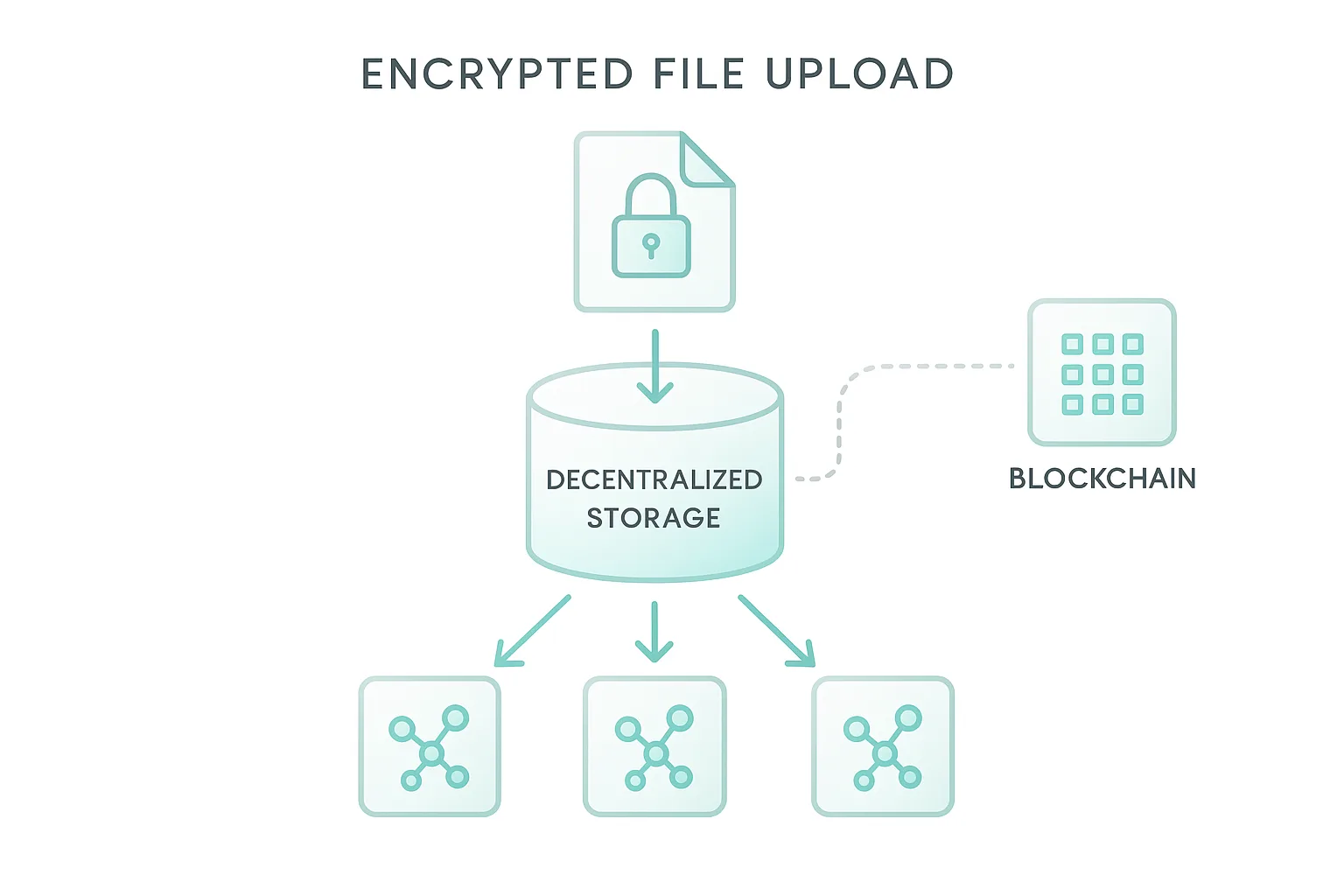
Files encrypted before they leave your device with keys you control — storage providers never see plaintext.
Document hashes committed to a public blockchain, creating tamper-evident, independently verifiable proof of existence and integrity.
IPFS-based or hybrid storage removing single-provider failure and censorship risk for critical archives.
Recipients and third parties can verify a file's authenticity and timestamp without any account or trust relationship.
Every revision hashed and anchored, producing a complete, provable document history.
Upload, organise, and share through a clean web interface — the blockchain layer requires zero user expertise.

This model fits wherever trust between parties is expensive or impossible to establish:
In each case, blockchain anchoring removes the need for a trusted intermediary.
We identify which documents genuinely benefit from on-chain proof and define retention, access, and verification requirements.
Storage topology, encryption and key-management model, and chain selection balanced for cost, longevity, and verification needs.
Platform implementation with API hooks into your existing document workflows and systems.
End-to-end verification testing with your stakeholders and training on the proof workflow for non-technical users.
In a world where documents can be edited and claims can be disputed, cryptographic proof of existence and integrity is not a luxury — it is foundational to trust.
No — that would be impractical and expose your data. Files live encrypted in decentralised or hybrid storage; only a cryptographic fingerprint (hash) goes on-chain. The hash proves integrity and timestamp but reveals nothing about content.
Cloud storage protects against loss; it cannot prove a file was not altered by you or anyone else. Blockchain anchoring adds independent, third-party-verifiable proof of existence and integrity — which matters in disputes, audits, and credential verification where your own word is not evidence.
Key management is designed into every deployment: options include enterprise key escrow, multi-party recovery schemes, and HSM-backed custody. We agree the recovery model with you up front, because with client-side encryption, lost keys with no recovery path mean unrecoverable data — by design.
We evaluate cost, finality, longevity, and verification requirements together. Ethereum, Polygon, and Solana are common anchors; for long-term compliance archives, Bitcoin is an option. Chain selection is part of architecture design and depends on your use case.
Yes. Verification can happen through our web interface or via API. For maximum transparency, a third party can independently query the blockchain and compute the hash themselves — requiring no account or relationship with us.
Whether you need to archive compliance records, issue verifiable credentials, or protect creative IP, blockchain-anchored storage turns documents into independently verifiable evidence.
// CONTINUE EXPLORING
Up to the category, across to complementary services, and into the engine-room notes.