

// CASE STUDY
Face Recognition Check-In at Expo Scale | Consent-First Design
4 min read
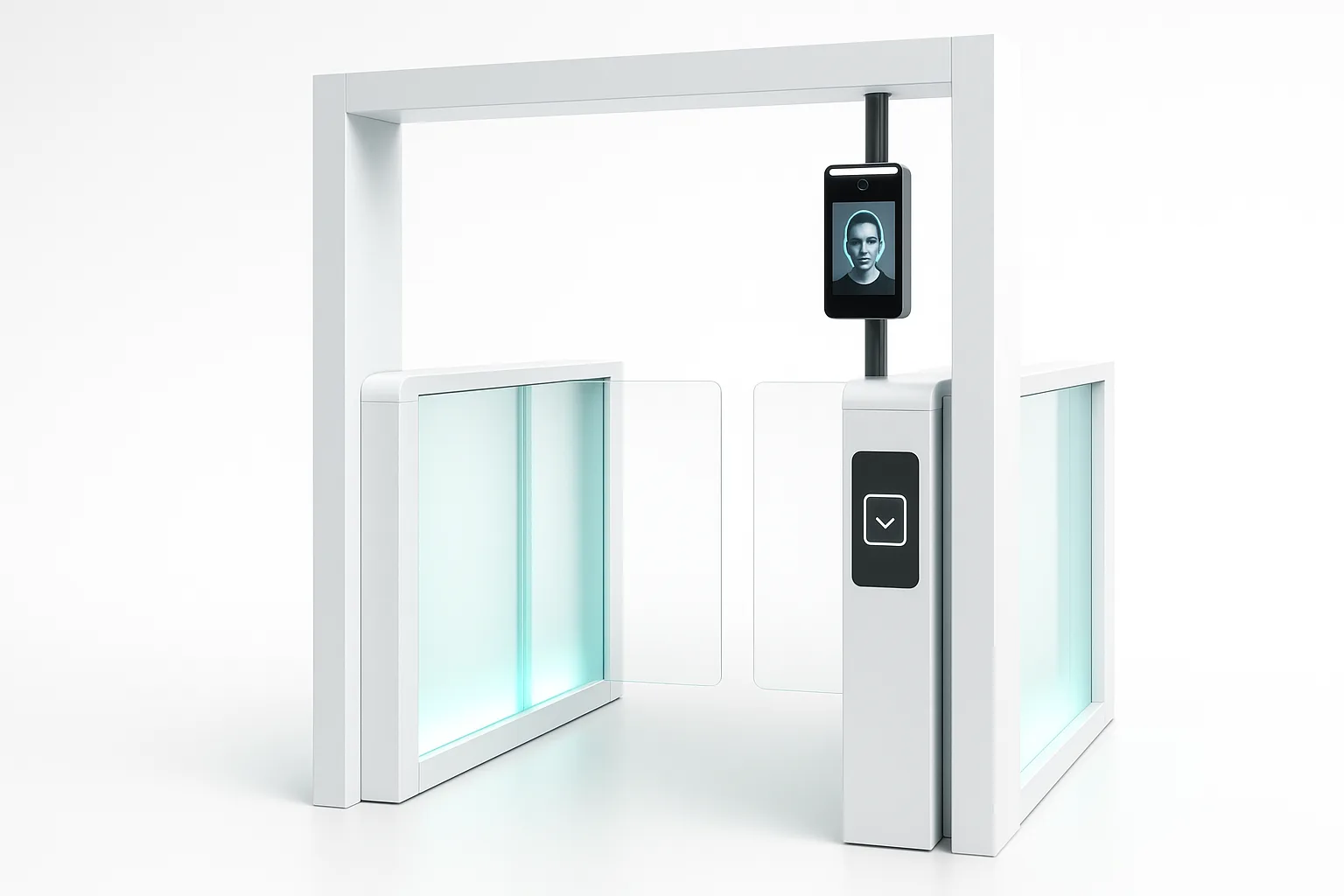
Large exhibitions struggle with entry bottlenecks, badge fraud, and blind occupancy data. Face recognition offers a faster, more secure alternative — but only when designed around explicit consent, transparent data handling, and real-world reliability. This case study explores how a consent-first biometric entry system replaced printed badges and queue congestion at a major exhibition, delivering measurable throughput gains alongside genuine privacy safeguards.
The Challenge: Queues, Fraud, and Occupancy Blindness
Large-scale exhibitions face three interconnected problems:
- Morning queue surges: Peak entry windows create visible bottlenecks, limiting fire safety insight into real-time occupancy.
- Badge fraud and loss: Printed credentials are easily duplicated or misplaced, opening venues to unauthorised access and complicating analytics.
- Occupancy blindness: Without real-time entry data, floor managers cannot detect crowding, enforce capacity limits, or route VIP attendees efficiently.
The venue needed a system that could process attendees in seconds, eliminate fraud, provide live occupancy data, and comply with biometric data protection regulations.

Consent-First Architecture: Four Core Components
Opt-In Enrolment with Transparent Consent
Face recognition is entirely voluntary. Attendees make their consent decision at registration with clear language explaining data use (entry matching only), retention (event duration plus defined window), and access controls (venue controllers and organisers only). Full audit trail logged for every consent decision.
Edge Inference and Venue-Optimised Matching
Biometric matching happens locally at entry points, not on remote cloud servers. This minimises latency to under 500ms, reduces network dependency, and keeps sensitive matching logic secure. Recognition models are tuned for Indian venue conditions—variable lighting, dense crowds, masks, and head coverings.
Integrated Access Control Enforcement
Per-hall permissions, session-restricted areas, and VIP routing are enforced through a unified rules engine. QR codes and badge lanes remain fully functional as fallback, ensuring no attendee is locked out if face recognition fails.
Real-Time Occupancy and Floor Management Intelligence
Every entry feeds a live event bus driving command-centre dashboards. Organisers see entry rates per minute, per-hall headcount, crowding predictions, and VIP arrival alerts—enabling proactive capacity management instead of reactive responses.

Real-Time Operational Visibility
Live occupancy dashboards transform floor management from reactive to proactive. Entry rate tracking shows attendees per minute with peak-hour detection. Per-hall counters enable capacity enforcement. Crowding alerts flag congestion before it happens. VIP routing intelligence coordinates seamless host experiences.
This granular, real-time data gives organisers the control that badge-only systems simply cannot provide.
Performance and Reliability
Deployment and Operations
1. Pre-Event Testing and Tuning
Lighting simulation across venue conditions, demographic fairness evaluation, load testing for 200+ concurrent entries, and fallback scenario validation. Model fine-tuning on masked and bespectacled faces improves real-world accuracy.
2. Day-of Monitoring and Real-Time Adjustment
Dedicated command-centre staffing watches occupancy dashboards and responds to alerts. Entry lane operators handle marginal matches and escalate technical issues. Lighting and confidence thresholds are adjusted on-the-fly if specific lanes underperform.
3. Post-Event Data Governance and Purging
Biometric templates are retained for 60–90 days (dispute resolution window). Automated purging on day 61 deletes all templates with cryptographic proof logged. Organisers receive comprehensive post-event analysis including entry patterns, peak hours, and any technical incidents.
Biometric entry systems succeed when they marry trust and throughput. Consent-first design builds trust; edge inference and tuned models deliver throughput. When both are designed in from the start, the technology becomes invisible because it simply works.
Privacy, Compliance, and Attendee Questions
Is my biometric data sold or shared with third parties?
No. Biometric templates are encrypted, used only for entry matching during the event, and automatically purged after the defined retention window. They are not shared with third parties, not used for marketing, and not retained beyond the event lifecycle.
What if I don't want to use face recognition?
Face recognition is fully opt-in. Attendees who prefer traditional entry use QR codes or printed badges with no loss of access or experience. Fallback lanes operate seamlessly alongside biometric entry.
How does this comply with data protection laws?
The system is designed to meet GDPR (lawful basis: explicit consent; purpose: entry control; retention: event duration + dispute window), DPDP Act (India), and local regulations. Legal review and data protection impact assessment are mandatory before deployment.
What happens if the system fails during peak hours?
QR and badge lanes remain fully operational as graceful fallback. Entry staff can manually verify credentials and grant access. The system is designed to degrade gracefully, not fail hard, ensuring no attendee is locked out.
Can I request a log of my entries or demand deletion of my data?
Yes. Attendees can request an audit log of their own entry events. Biometric templates are automatically purged after the event; deletion is logged and archived. Additional deletion requests can be honoured immediately.
How accurate is the system in real-world conditions?
Edge-deployed systems typically achieve 98–99% true-match accuracy under optimal lighting. Accuracy is lower in dim conditions or with heavy occlusion (mask + glasses), which is why marginal matches are escalated to trained staff. The system prioritises false-rejection over false-acceptance to prevent fraud.
Ready to Reimagine Expo Entry?
Eliminate queues, fraud, and occupancy blindness with consent-first biometric entry. ZebIQ Technology designs and deploys event-scale face recognition systems that attendees trust and floor managers can rely on.
